
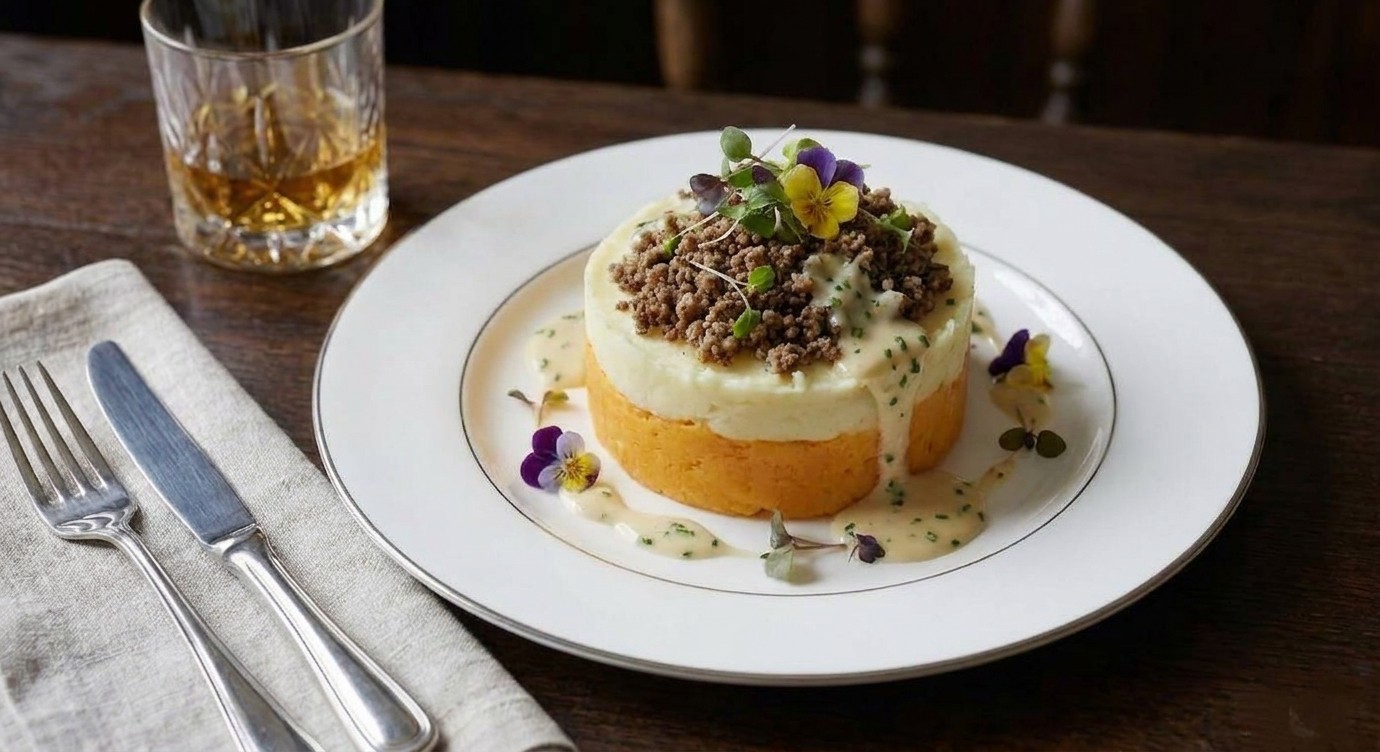
Haggis, Neeps & Tatties
Burns Night on a plate. Best butcher's haggis, buttered neeps, creamed tatties, whisky-chive cream over the top.
Haggis, neeps and tatties is the dish most Scot grows up on and every Burns Night turns into a ceremony. It's deceptively simple and that's the trap — three components on a plate, each one capable of being ruined in a different way. Boil the haggis hard and the casing splits and the filling washes into the water. Boil the neeps and tatties together in the same pot and the swede leaches into the spuds and the whole thing turns a sad orange. Make the whisky cream sauce over a high flame and it splits before it hits the plate. Done properly, this is one of the great supper plates of northern Europe — peppery, peaty, sweet, creamy, sharp, all in one mouthful. Buy the best butcher's haggis you can lay hands on (Macsween if you're in the UK, Inverloch or Stuart's Pork Shop if you're in Australia, any reputable Scottish butcher anywhere else). Supermarket plastic-sleeve haggis is sawdust with seasoning and will not deliver this dish.
Haggis is already cooked when you buy it — your job is to reheat it slowly enough that the suet melts, the oats swell, the spice opens up, and the casing stays intact. A bare-tremble water bath at 80–85°C does that perfectly: hot enough to warm the centre through, never hot enough to make the casing seize and split. Proper neeps bring the sweetness to the plate. Cook them until completely tender, drain them properly, and fold in cold butter off the heat. Done right they turn sweet, rich and glossy instead of watery and dull. Floury potatoes mashed with warm cream and butter give the third leg — soft, rich, and silky enough to act as the sauce-carrier on the plate. The whisky cream sauce is the bridge: shallot sweated in butter, whisky off the heat (never poured into a hot pan or the alcohol flashes off before the flavour develops), cream reduced at a tremble, finished off the heat with cold butter, mustard, lemon and chives so the emulsion holds. Four pots, one plate, twenty minutes of active work — but every single step matters.
- →Haggis goes in cold water, never boiling. Drop a cold haggis into boiling water and the casing seizes, contracts, and splits — the filling washes out and you've lost the dish. Start it in cold water, bring up slowly to 80–85°C (a bare tremble, never a roll), hold it there for the duration. The casing stays taut, the inside heats evenly, the suet melts cleanly.
- →Neeps want proper cooking and proper butter. Cook them until completely tender, drain them hard, then let the steam escape before mashing. Fold in cold butter off the heat and they turn sweet, rich and glossy instead of watery and dull.
- →Dry the spuds before they get the butter. A wet mash is a gluey mash. After draining, return the potatoes to the dry pot over low heat for 60–90 seconds, shaking — you'll see steam come off. Now they can absorb cream and butter properly and the mash turns silky instead of pasty.
- →Cold butter into hot mash, off the heat. Whether it's neeps or tatties, fold the butter in off the heat in small pieces. Hot butter melted in beforehand goes oily on the surface; cold butter folded in emulsifies into the starch and gives the mash its gloss. The cream into the tatties goes in warm (not boiling) for the same reason — keeps the texture, doesn't loosen it.
- →Whisky goes in cold, off the heat. Pour whisky into a screaming-hot pan and the alcohol flashes off before the flavour develops — you keep the burn, lose the smoke. Pull the pan off the heat, add the whisky, swirl, return to low heat to reduce gently. You keep the smoke, the peat, the malt, and lose the raw alcohol bite.
- →Keep the whisky cream sauce gentle. Reduce it slowly at a bare tremble, never a hard boil, then finish with cold butter and chives off the heat so it stays glossy and smooth. If it does split, take it off the heat and whisk in a splash of cold cream hard to bring it back.
- →Serve hot plates. This dish goes cold faster than almost anything else on a Scottish table — three mashes lose heat the moment they hit a room-temperature plate. Warm the plates in a low oven (80°C, 5 minutes) before serving. Non-negotiable on a winter night.
Common Mistakes
- ✗Cheap haggis. Supermarket plastic-sleeve haggis is bulked with rusk, low on offal, low on suet, and tastes of nothing. Go to a butcher, ask for their best, pay for it. The whole dish hangs on this single ingredient.
- ✗Dropping the haggis into boiling water. The casing seizes, contracts, and splits — you'll see the filling start to leak into the water. Always start in cold water and bring up slowly. Same applies to gently reheating in an oven bath.
- ✗Hard-boiling the haggis the whole time. A rolling boil for an hour also splits the casing. Once you've got the water up to temperature, drop the heat and hold at a bare tremble — surface barely moving, the occasional bubble.
- ✗Undercooked neeps. If there's still resistance when the knife goes in, keep cooking. A good neep mash should be soft, smooth and buttery, not lumpy and fibrous.
- ✗Wet mash. Drain the potatoes and the neeps, then put each back in the dry pot over low heat for a minute to drive off surface water. Mash a wet potato and you get glue.
- ✗Hot butter melted into mash. Cold butter folded in off the heat is the rule for both mashes — gives the gloss. Hot butter slicks the surface and dulls the texture.
- ✗Boiling the whisky cream. The moment it rolls, the cream breaks. Bare tremble while reducing, butter and chives off the heat.
- ✗Cheap blended whisky for the sauce. You don't need an Islay peat-bomb, but you do need something with character — a decent Speyside (Glenfiddich 12, Aberlour 12), or a lightly peated Highland (Highland Park 12, Old Pulteney). Bell's and Famous Grouse leave the sauce flat.
- ✗Cold plates. The mash loses heat the second it hits a cold plate and the suet in the haggis dulls. Warm the plates.
Tips & Tricks
- →Mash too stiff? A splash more warm cream into the tatties; a knob more cold butter into the neeps. Both should sit just on the side of soft.
- →Whisky sauce split on you? You boiled it. Take it off the heat, whisk in a tablespoon of cold cream and a knob of cold butter hard — that usually brings it back. If it won't, blitz briefly with a stick blender.
- →Big crowd? Scale up the haggis (allow 200–250 g per person), keep the mashes hot in covered dishes in the warming oven, and triple the whisky sauce — people pour more than you'd think.
- →Burns Night version: pipe the haggis to the table on a wooden board, read the Address to a Haggis, slit the casing on the toast line ('His knife see Rustic-labour dight, An' cut you up wi' ready slight'), then carry it back to the kitchen to plate up.
Flavour Twists
Swap the Speyside for an Islay whisky in the cream sauce — Laphroaig 10, Lagavulin 16, Bowmore 12. The smoke runs straight through the cream and the dish reads like a smoked haggis. Halve the quantity (40 ml) — peated whisky is loud.
Mash the neeps and tatties together instead of separately — Orkney's traditional answer to the dish. Cook them in separate pots still (timing differs), drain hard, then combine in one pot with all the butter, cream, salt, pepper and a small handful of finely chopped chives. Single mash on the plate, haggis alongside, whisky sauce over.
After lifting the haggis from the water, slit the casing, brush the exposed surface with a tablespoon of whisky mixed with a teaspoon of honey, and slide under a hot grill (broiler) for 90 seconds until lacquered. Sweet, boozy, caramelised top on what's normally a soft dish.
Substitutions
- Turnip (neep)→ Use a proper neep.This is haggis, neeps and tatties. The neep isn't an optional extra.
- Floury potatoes→ Sebago, King Edward, Maris Piper or Russet will give the fluffiest mash.Avoid waxy potatoes such as kipfler, charlotte and baby new potatoes.
- Scotch whisky→ Irish whiskey (Redbreast 12, Jameson Black Barrel) or a decent bourbon (Maker's Mark, Woodford Reserve).Irish whiskey gives a softer, fruitier sauce. Bourbon pushes it sweeter and a little oakier. Both work; neither is the original. Avoid blended supermarket whiskies — the sauce reads flat.
- Pouring cream (35%+)→ Crème fraîche, or a 50/50 cream–crème fraîche mix.Crème fraîche is more stable and won't split as readily — easier for nervous cooks. Sour cream splits on heat — don't substitute.
- Chives→ Spring onion greens (the green tops only), or flat-leaf parsley.Spring onion is sharper, parsley is softer. Chives are right, but either substitute works in a pinch. Avoid dried chives — they taste of nothing.
Haggis: cooked-and-cooled haggis keeps 3 days in the fridge tightly wrapped. Freezes well — 3 months. Mashes: 2 days in the fridge. Whisky cream sauce is best made fresh.
Haggis is the spice — black pepper, white pepper, mace, nutmeg, sometimes coriander seed and allspice, all already inside the casing. Your job everywhere else is restraint: salt the boiling water for the neeps and tatties properly, white pepper on the mashes, fresh nutmeg on the neeps. Resist adding warm spice (cumin, cinnamon, paprika) to the mashes — it doubles up on what's in the haggis and pushes the dish into curry-adjacent territory. The whisky cream sauce carries the bright notes (chive, mustard, lemon) that the mashes don't.
Buttered kale with cider vinegar
The plate is rich, fatty, deep. It needs something green, sharp and quick on the side or the table goes one-note. Kale wilted in butter and finished with cider vinegar takes 5 minutes — bitterness from the kale, fat from the butter, acid from the vinegar to cut the cream sauce.
- Cavolo nero or curly kale1 large bunch
- Butter30 g
- Garlic clove1
- Cider vinegar1 tbsp
- Sea salt + cracked pepperPinch
- 1.Wilt fast. Wide pan, medium-high heat. Melt the butter, add the garlic, 30 seconds. Pile the kale in, salt it, toss for 2–3 minutes until just wilted and still bright green — don't cook it grey.
- 2.Finish with acid. Off the heat. Splash the cider vinegar over, toss, cracked pepper, serve straight away alongside the plate.
"Fair fa' your honest, sonsie face, Great chieftain o' the puddin'-race! Aboon them a' ye tak your place, Painch, tripe, or thairm: Weel are ye wordy of a grace As lang's my arm."
— Robert Burns, Address to a Haggis
Haggis, neeps, tatties, whisky cream. Four things on a warm plate. Nothing else needed.
Method
- 1
Get the haggis on first — cold water, slow climb
Lift the haggis out of its packaging (leave the natural casing on — that's the cooking vessel). Pierce it once on top with the tip of a sharp knife — a single small vent stops pressure building inside. Lay it in a deep pot, cover completely with COLD water by at least 5 cm. Onto a medium-low flame. Bring the water up slowly over 20 minutes until the surface is at a bare tremble — small bubbles working up the side of the pot, never a rolling boil. Drop the heat to its lowest setting and hold the haggis there for 50–60 minutes for a 900 g haggis (allow 30 minutes per 500 g as a rule). DON'T let it boil at any point — the casing splits.
- 2
Warm the plates, start the neeps
Plates into a low oven (80°C / 175°F) to warm. Peel the swede and chop into even 3 cm chunks — swede is tough so use a heavy knife and take your time. Into a separate pot of well-salted cold water (1 tsp salt per litre — neeps want seasoning all the way through). Bring to a simmer and cook 20–25 minutes until a knife slides through with no resistance. Drain HARD in a colander, shake to get rid of surface water.
- 3
Start the tatties
Peel the floury potatoes and cut into even 4 cm chunks (even sizes = even cooking — non-negotiable). Into a third pot of well-salted cold water. Bring to a simmer and cook 18–22 minutes until a knife slides through with no resistance. DON'T fork-test repeatedly — every poke lets water in. Drain HARD.
- 4
Dry the mashes in their own pots
Return the drained swede to its dry pot over low heat for 60 seconds, shaking — you'll see steam come off. Same with the potatoes in their dry pot. This step is what separates a silky mash from a wet one. The starch on the surface dries slightly and is now ready to absorb fat and cream cleanly instead of weeping water into them.
- 5
Mash the neeps off the heat
Pot off the heat. Mash the swede with a potato masher or pass through a ricer (ricer gives the smoothest result; masher gives a more rustic texture — both are right). Fold in the cold butter cubes a few at a time until they melt into the mash and the surface goes glossy. Grate over plenty of nutmeg, crack in the white pepper, salt to taste. Cover and keep warm — it'll hold 10 minutes off direct heat.
- 6
Mash the tatties off the heat
Pot off the heat. Warm the cream in a small saucepan or the microwave until just hot to the touch (50–60°C — NOT boiling, or it'll loosen the starch and you'll get glue). Mash or rice the potatoes. Fold in the cold butter cubes off the heat until glossy, then stream in the warm cream, folding gently — don't beat or you'll work the starch and the mash turns sticky. Salt and white pepper to taste. Cover and keep warm.
- 7
Build the whisky cream sauce — last 10 minutes
Small saucepan, low heat. Melt the 20 g of butter, sweat the shallot 3–4 minutes until soft and translucent — don't brown. PULL THE PAN OFF THE HEAT. Pour in the whisky, swirl. Return to low heat and let it reduce by half (~2 minutes) — bare simmer, never a roll. Stir in the Dijon and wholegrain mustards. Pour in the cream. Hold at a bare tremble — surface barely moving — for 4–5 minutes until just thickened enough to coat the back of a spoon. PULL OFF THE HEAT. Whisk in the cold 20 g butter in two pieces, the squeeze of lemon, and the chives. Taste. Salt, white pepper. The sauce should be sharp, boozy, creamy, herby.
- 8
Plate up
Lift the haggis carefully out of the water with two slotted spoons or a fish slice — it's fragile when hot. Onto a board. Slit the casing lengthways with a sharp knife and peel it back like opening a book — the filling steams up and that's the proper Burns Night moment. On each warmed plate: a generous scoop of tatties, a generous scoop of neeps, and a scoop of haggis spooned out of the casing. Pour the whisky cream sauce generously over the haggis (it's the bridge between all three). A small splash of extra whisky in a glass alongside. Serve immediately — the mashes lose heat fast.
More Cooking lessons
Cook with it
Leave a comment
Drop your name, email and a note — I read every one.