
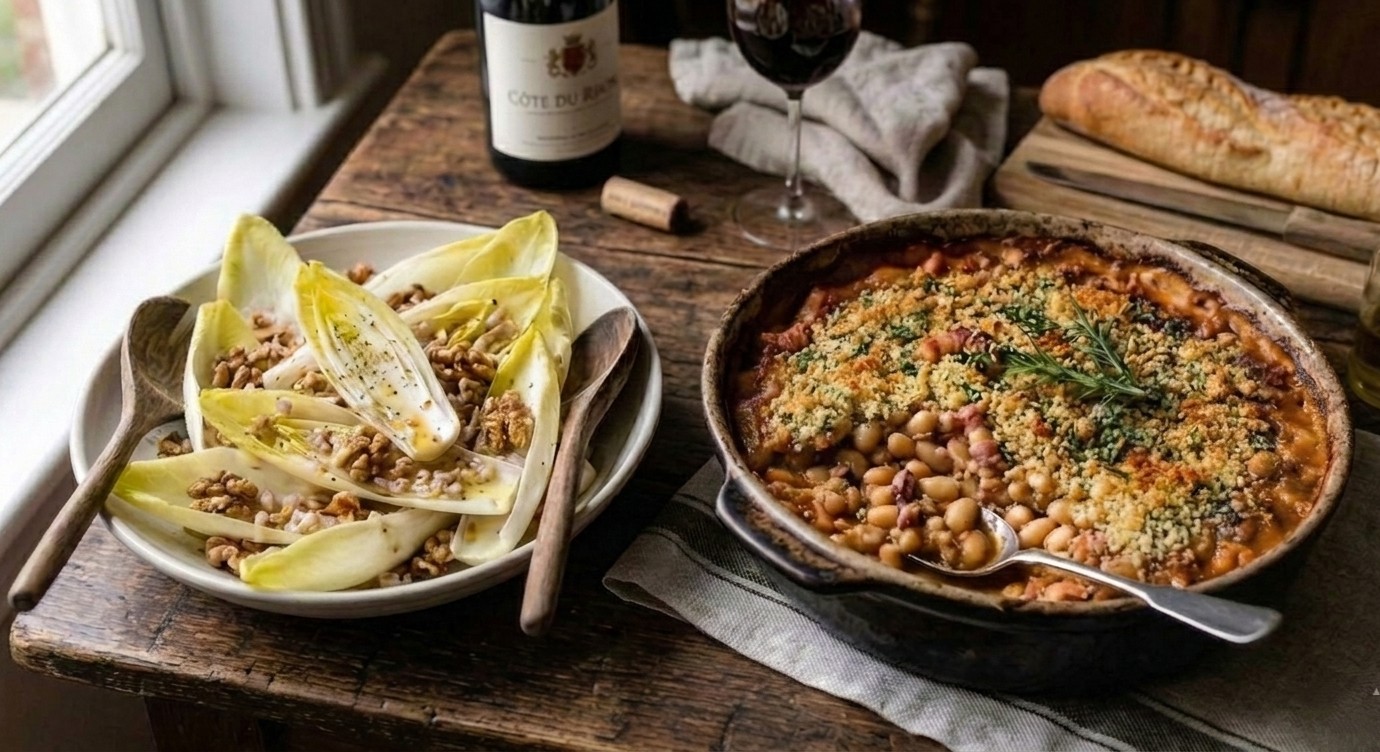
French Cassoulet
Beans, pork, duck, time. The southwest of France in a single pot.
Cassoulet has a reputation for being a project. It isn't — it's mostly waiting. The active cooking is straightforward; the magic is in the bean broth, the bare simmer, and the crust you break back into the pot. Get those three right and you've got the kind of one-pot dinner people remember for years. This is the home version: no goose, no week of preparation, no arguments about which town owns the original. Just the technique that makes it work.
Cassoulet is a slow conversation between beans, fat and time. The beans cook in seasoned broth until they're creamy on the inside and just-holding on the outside — that's where the body of the dish comes from. The duck confit and seared sausage bring rendered fat that coats every bean. Low oven heat melts the pork shoulder's collagen into silk without ever breaking the bean skins. The breadcrumb crust isn't decoration — pushing it back into the pot three times builds a layered top that's part-crisp, part-gravy, and seasons the whole pot from above.
- →Bean cookery is seasoning, not boiling. Salt the bean water early and the beans cook seasoned all the way through — under-seasoned beans taste of nothing and no amount of finishing salt rescues them. The old rule about salt toughening beans is a myth; what toughens them is hard-boiling, not seasoning.
- →Bean starch is the natural thickener. The cloudy liquid the beans cook in is loaded with leached starch — that's the body. Drain it off and you've thrown away the sauce. Keep it, and the pot binds itself with no flour, no roux, no cream.
- →Maillard on the meat is non-negotiable. Pat the sausage and pork shoulder dry, sear them dark in duck fat before they go anywhere near the pot. That crust is where the deep, savoury back-note comes from — without it the dish tastes flat no matter how long it cooks.
- →Low oven, bare simmer. Above ~90°C the bean skins split, the meat squeezes its moisture out, and the whole pot turns muddy. Hold it at a lazy bubble — surface barely moving — and the collagen in the pork shoulder melts into the broth instead.
- →The crust push-back is the trick. Scatter breadcrumbs over the top, let them brown, then push them gently back into the surface. New breadcrumbs, brown again, push back. Three times for home cooks (the legendary seven is for restaurants with patience to burn). Each layer melts into the broth and the next one crisps on top — you end up with a top that's simultaneously crusted and saucy.
Common Mistakes
- ✗Skipping the overnight soak. Dried beans need the water back before they cook, otherwise the outside softens before the inside even starts. Quick-soak methods get you 70% of the way — soak overnight if you can.
- ✗Hard simmering the beans. A rolling boil rips the skins off and turns the beans to mush. You want a bare tremble on the surface and nothing more.
- ✗Under-seasoning the bean broth. The broth IS the sauce — taste it before the meats go in. If the broth's flat at that stage, the finished dish will be too.
- ✗Wrong sausage. Lean dinner sausages or cured chorizo throw the dish off. You want a coarse, fatty, garlicky fresh pork sausage — Toulouse-style if you can find it, a good butcher's coarse pork sausage if you can't.
- ✗Skipping the crust push-back. One crust on top is fine. Three is cassoulet. It's the difference between a bean stew and the actual dish.
- ✗Adding the duck confit too early. Confit is already cooked — bury it in the pot from the start and it falls apart and disappears. It goes in for the final stretch so it warms through and the skin crisps under the breadcrumbs.
Tips & Tricks
- →Pot too dry before the final crust? Slip a ladle of warm stock down the side of the pot — never over the top, or you'll wash the crust off.
- →Pot too loose at the end? Give it another 10 minutes uncovered. The starch in the beans pulls it back together as it rests.
- →Tastes flat? Cassoulet wants salt — the beans soak up more than you'd think. Crack pepper liberally between crust layers too.
- →No earthenware cassole? A wide, shallow Dutch oven is fine. You want more surface area than depth — that's where the crust forms.
- →Bean broth is everything. If you ever find yourself draining beans before adding them to the pot, stop. That liquid IS the sauce.
- →Better on day two. The beans drink the broth overnight and the flavours marry. Reheat covered at 150°C with a splash of stock until hot through, then uncover for the last 10 minutes to re-crisp the top.
Flavour Twists
Skip the duck confit and lean harder into pork — extra shoulder, an extra pancetta hit, and a piece of pork rind tucked into the broth while the beans cook. Cheaper, heavier, equally legitimate. The original cassoulet, depending on who you ask.
Confit duck stays, Toulouse sausage takes centre stage. The version above is already leaning Toulouse — add a chunk of slow-cooked lamb shoulder alongside the pork for the full Toulouse treatment.
Crumble 100g of black pudding through the final breadcrumb layer. It melts down into the crust as it bakes, adds a peppery, iron-rich savoury edge, and turns the top from golden to deep mahogany. Very wrong by French standards. Very right at a Scottish table.
Tinned cannellini (4 × 400g, drained but reserve the liquid), shop-bought roast chicken thighs in place of confit, good butcher's sausages, smoked pancetta. Skip the 90-minute pork braise — use diced cooked ham instead. Two crust pushes instead of three. On the table in 90 minutes. Not the real thing, but close enough for a Tuesday.
Substitutions
- Cannellini beans→ Great northern, large white beans, or Tarbais if you can hunt them down at a specialty deli.Cannellini is the easy Aussie supermarket pick and works perfectly. Tarbais are the French original — thinner skins, better shape retention — but you're paying for an import. Avoid butter beans (too soft) and haricot (too small).
- Duck confit→ Slow-roasted chicken thighs (bone-in, skin-on, 150°C for 90 minutes in duck fat).You're after rich, falling-off-the-bone poultry with a crisp skin. Chicken thighs cooked this way get you 80% of the way for a fraction of the cost. Don't use shredded rotisserie chicken — the texture's wrong and the skin's gone.
- Toulouse-style pork sausage→ Any good coarse, fatty fresh pork sausage with garlic.Avoid lean, finely-ground or pre-cooked sausages — you need fat to render into the broth and texture that holds up to the long cook. Add an extra clove of garlic to the base if your sausage isn't garlicky.
- Pork shoulder→ Pork belly (skin off), or lamb shoulder.Belly gives more fat and a softer finish. Lamb pushes the dish in a different direction — earthier, gamier — and is the traditional addition in the Toulouse and Carcassonne versions.
- Chicken stock→ Vegetable stock + a parmesan rind, or weak beef stock.Avoid stock cubes if you can — they oversalt the bean broth before you've had a chance to season it yourself. If cubes are all you've got, use half the recommended strength.
- Duck fat→ Lard, bacon fat, or olive oil + butter.Duck fat is the right answer because it's already in the dish via the confit. Lard is the historical second choice. Olive oil works but loses the southwest-France character.
Fridge 4 days, sealed. Freezer 3 months in portion tubs — texture holds up surprisingly well. Reheat in a low oven (150°C, covered) with a splash of stock; uncover for the last 10 minutes to crisp the top back up. Microwave reheats split the broth — don't.
Cassoulet is not a spiced dish — it's a seasoned one. Whole cloves and bay carry the aromatic load through the broth; black pepper does the lifting on the plate. Resist the urge to add paprika, herbes de Provence or anything that turns it into something else. The flavour is meant to be deep and quiet, not loud.
Sharp witlof, walnut & Dijon salad
Cassoulet is rich, savoury, deep. It needs something bright and bitter on the side or the table goes one-note. This salad takes 4 minutes and does the whole job — bitterness from the witlof, acid and mustard from the dressing, fat and crunch from the walnuts. Don't dress it until the cassoulet is on the table.
- Witlof3 heads
- Walnuts60 g
- Dijon mustard1 tbsp
- Sherry or red wine vinegar1 tbsp
- Extra virgin olive oil3 tbsp
- Shallot1 small
- Sea salt + cracked pepperPinch
- 1.Build the dressing. In the bottom of the serving bowl, whisk the Dijon, vinegar, shallot, salt and pepper. Stream in the olive oil while whisking until thick and glossy.
- 2.Dress at the table. Pile witlof leaves on top of the dressing. Scatter walnuts over. Toss at the last second — witlof wilts fast once dressed. Serve in the same bowl alongside the cassoulet.
"Some hae meat and canna eat, and some wad eat that want it; but we hae meat and we can eat, and sae the Lord be thankit."
— Robert Burns, The Selkirk Grace
Beans, pork, duck, time. Get those four right and the pot does the rest.
Method
- 1
Soak the beans overnight
Cover the beans with cold water by 5 cm and leave 8–12 hours on the bench. Drain and rinse. DON'T skip — un-soaked beans cook unevenly and you'll be chasing the texture for the rest of the night.
- 2
Cook the beans in seasoned broth
Put soaked beans in a big pot with the smashed garlic, one onion halved, a bay leaf, the cloves and a teaspoon of salt. Cover with cold water by 5 cm. Bring to a bare simmer (NOT a hard boil) and cook 45–60 minutes until tender but still holding shape. Taste the cooking liquid — it should taste like a light, savoury broth. Keep the beans IN their cooking liquid. DON'T drain — that starchy liquid is the sauce.
- 3
Render the pancetta, sear the meats
Cold pan, low heat. Drop the pancetta in dry and let the fat render slowly until golden and crisp (~8 minutes). Lift out, leave the fat. Crank the heat. Pat the pork shoulder dry, salt it, sear it dark in two batches — single layer, don't stir for 90 seconds. Out. Sear the sausages whole until deep brown all over but still raw in the middle. Out. DON'T crowd the pan — wet, packed meat steams instead of browning and you lose the whole back-note.
- 4
Build the base
Drop the heat to medium. Sweat the remaining onion, carrot and whole garlic cloves in the rendered fat with a pinch of salt for 10 minutes. Stir in the tomato paste and cook 2 minutes until it darkens a shade. Pour in the white wine and reduce by two-thirds, scraping up any fond. Add the pork shoulder back in, the chicken stock, the second bay leaf and the thyme. Bring to a bare simmer.
- 5
Slow braise the pork
Lid on, drop to the lowest flame your hob will hold, and cook 90 minutes until the pork is fork-tender. Pre-heat the oven to 150°C / 300°F. Slice the sausages into thick rounds. Lift the duck confit legs out of their fat, scrape most of the jelly off, and have them ready.
- 6
Assemble in a wide pot
Tip the cooked beans WITH their broth into a wide, deep oven-safe pot (Dutch oven, earthenware cassole if you have one). Stir in the braised pork shoulder and its liquid, the rendered pancetta, and the sliced sausages. Nestle the duck confit legs on top, skin-up. The liquid should come about three-quarters up the beans — if it doesn't, top up with stock. Taste. Adjust salt and pepper. Crack pepper generously over the top.
- 7
First crust
Scatter a third of the breadcrumbs evenly over the top. Slide into the oven, uncovered. Bake 40 minutes until the crumbs are golden and a bubbling crust has formed.
- 8
Push back, second crust
Pull the pot out. Use the back of a spoon to gently push the golden crust down into the surface — don't stir it in, just press it under. Scatter another third of the breadcrumbs over the top. Back in the oven for 30 minutes.
- 9
Push back, third crust
Repeat — push the crust down, scatter the last of the breadcrumbs, back in the oven for 25–30 minutes until the final top is deep golden and the pot is bubbling at the edges. DON'T push the final crust down — that one stays on top.
- 10
Rest, then serve
Rest the pot on the bench for 10–15 minutes off the heat — the broth thickens as it settles and the flavours pull together. Serve straight from the pot at the table. Crusty bread, a sharp green salad on the side, the rest of the white wine in glasses.
More Cooking lessons
Cook with it
Leave a comment
Drop your name, email and a note — I read every one.