
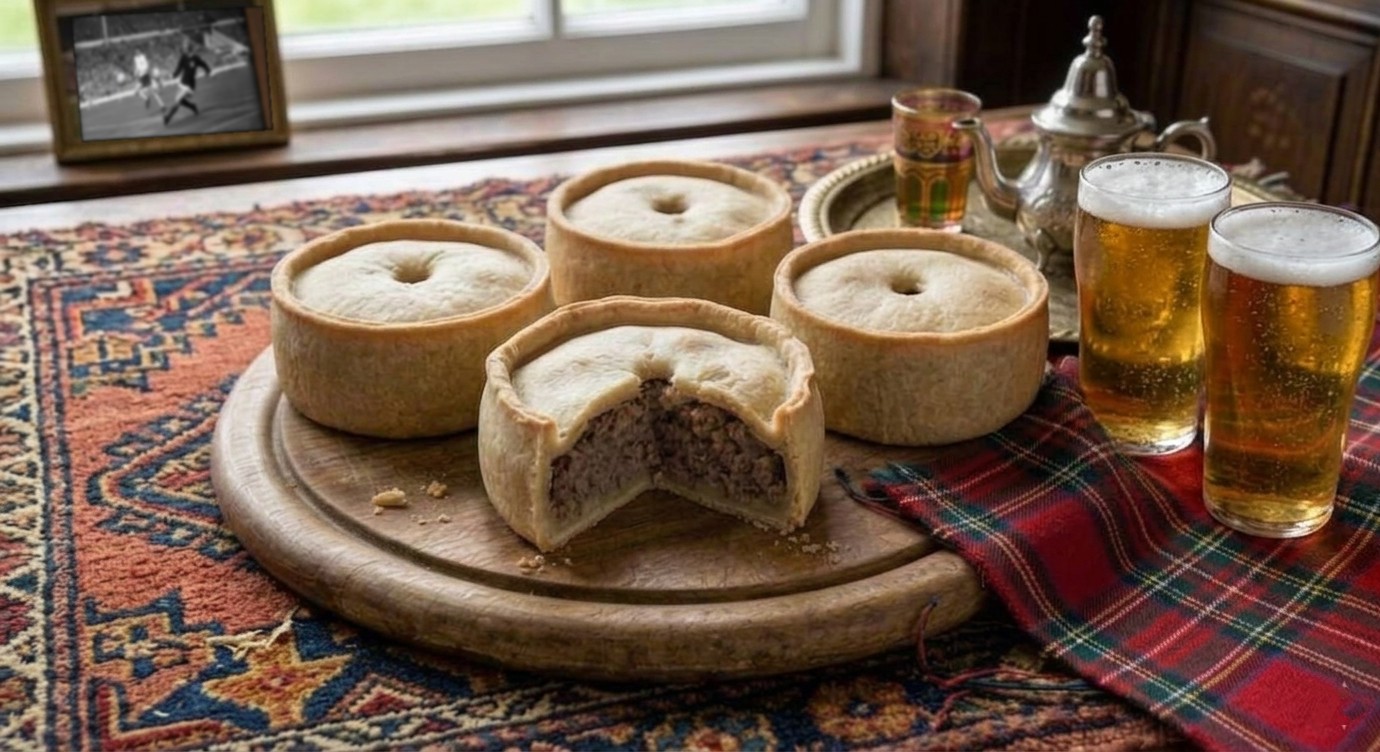
Haggis Merguez Scotch Pie
Scotland's at the World Cup. Build these for match day.
It's been since 1998. Twenty-eight years of near-misses, Hampden roars and Hampden silences. And now Scotland's actually at the World Cup. Wherever you're watching — kitchen, couch, bar, mate's flat halfway round the world — you don't mark a moment like this with a dip and carrot sticks. You build proper Scotch pies the day before, sit them in the fridge, then bang them in the oven so they're hot for kick-off. Merguez folded through the haggis, because if there was ever a moment for unhinged-but-correct cooking, it's this one. Hot water crust, deep-walled, lid sunk below the rim the way it should be. Cumin, harissa and fennel from the merguez crashing into the pepper, mace and offal of the haggis. Oven on. Eyes on the telly.
Scotch pie pastry is hot water crust for a reason — boiled lard and water bind the flour into a dough that's pliable hot, sets up sturdy cold, and seals tight enough to hold a heavily seasoned, fatty filling without leaking. Drop merguez and haggis into that case and the two fillings do each other favours: the merguez fat renders and bastes the haggis, the haggis oats soak the merguez juices back up so nothing escapes, and the harissa-cumin-fennel of one meets the pepper-mace-allspice of the other on the same fork.
- →Hot water crust seals as it sets — no soggy bottom, no leaking fat, and it holds a deep wall so you get proper filling-to-pastry ratio.
- →Sunken lid is the Scotch pie signature. It gives you a 1 cm well on top for gravy, brown sauce or just a pool of rendered fat. Don't flatten it.
- →Merguez and haggis share a fat content of around 25–30%, so they cook at the same rate and bind without one drying out before the other.
- →Steam hole in the lid is non-negotiable. Skip it and the lid blows or the bottom turns to mush.
- →Pulling the pies at 75 °C internal and resting 10 minutes lets the fat reset — first bite is rich, not lava.
Common Mistakes
- ✗Letting the pastry cool before you mould it. Hot water crust is moulded warm, full stop — cold dough cracks and your pies leak.
- ✗Skipping the steam hole. The lid will dome and split, or the bottom will go soggy with trapped steam.
- ✗Compacting the filling like a meatball. Pack it firm but don't squeeze the air out — dense filling bakes dry.
- ✗Slicing or biting in straight out of the oven. The fat is molten. Rest 10 minutes or you'll wear it.
- ✗Cheap supermarket haggis full of rusk and water. The filling needs the offal and suet of a butcher's haggis to stand up to the merguez.
Tips & Tricks
- →Work the pastry while it's still warm to the touch. Cold hot water crust cracks the second you try to mould it.
- →Dariole moulds, 9 cm tuna tins or even clean jam jars all work for shaping. Wrap them in baking paper first so the case slides off cleanly.
- →If your merguez is very wet, drain it in a sieve for 10 minutes before mixing — otherwise the filling loosens the pastry base.
- →Probe through the steam hole, not through the wall. You don't want a second leak.
Flavour Twists
Swap 320 g of the merguez for 320 g of minced lamb shoulder. Slightly leaner, slightly chewier, gives the pie a meatier bite under the spice.
Make a quick lamb gravy. Crack the steam hole open with a knife after baking and pour a tablespoon in just before serving. The well on top holds another spoonful.
Crack coarse black pepper over the egg-washed lid before baking. Pushes the haggis pepper notes forward against the merguez heat.
Substitutions
- Lard→ Beef drippingSame job, slightly beefier flavour through the pastry. Don't swap to butter or oil — hot water crust needs a solid fat that sets hard cold.
- Merguez sausage meat→ Lamb mince + 4 tsp harissa + 2 tsp ground cumin + 2 tsp ground fennel (per 960 g mince)Builds a rough merguez from scratch if your butcher hasn't got it. Still lamb — the heat and spice are what make it merguez.
Assembled raw, the pies hold 8 hours in the fridge under cling film — bake straight from cold, add 5 minutes. Cooked pies keep 3 days in the fridge, tightly wrapped. Reheat at 180 °C for 12–15 minutes — microwave kills the pastry. To freeze, assemble raw, freeze on a tray until solid, then bag. Bake from frozen at 200 °C for 50–55 minutes, checking the centre hits 75 °C.
Don't add any spice. Merguez is already harissa, cumin, fennel, garlic, sometimes sumac. Haggis is already black pepper, white pepper, mace, nutmeg, coriander and allspice. Between them you've got nine spices in the filling before you've touched a jar. Salt the pastry, season nothing else.
Pint and HP
A cold lager or a Scottish heavy. HP sauce in the well on top if you want it. That's the full kit.
Pies in the oven. Whistle about to go. Twenty-eight years was long enough.
Method
- 1
Mix the dry pastry
Tip the 1 kg flour and 2 tsp salt into a big bowl. Make a well in the middle. Have a wooden spoon ready — this dough goes together hot and you'll burn your hands if you try to use them first.
- 2
Boil lard and water
Put the 300 g lard and 400 ml water in a pan. Bring to a hard boil so the lard is fully melted and the whole lot is bubbling — not just warm.
- 3
Bring the dough together
Pour the boiling lard-water straight into the flour well. Stir hard with the wooden spoon until it pulls into a rough ball. As soon as it's cool enough to handle, knead 30 seconds in the bowl until smooth. Don't overwork it.
- 4
Rest the dough — but stay warm
Wrap in cling film and rest 10 minutes somewhere warm. Hot water crust must be moulded warm — once it goes cold it cracks. If your kitchen is cold, sit the wrapped dough on top of the oven while it preheats.
- 5
Mix the filling
Crumble the 640 g haggis into a bowl, add the 960 g merguez sausage meat. Mix with your hands just enough to combine — light touch, don't compact it or the pies bake dense. Divide into eight equal balls of about 200 g each.
- 6
Mould the cases
Cut the dough into 8 equal pieces. From each piece, pinch off about a quarter for the lid (set aside, covered). Roll the rest into a ball, flatten, and mould around the outside of a 9 cm dariole mould, jam jar or tin can wrapped in baking paper. Walls should be about 5 mm thick and 5 cm tall. Slide the mould out — you should have eight pastry cups.
- 7
Fill the pies
Sit each pastry case on a baking tray lined with paper — you'll need two trays for eight pies. Press a 200 g ball of filling into each one, level the top, and leave a clear 1 cm of pastry showing above the filling — that's the well the sunken lid sits in.
- 8
Lid and crimp
Roll each reserved piece of dough into a disc just bigger than the pie. Lay it on top so it sits 1 cm below the rim of the case — not on top, below. Pinch the wall down onto the lid to crimp. Poke a 5 mm steam hole dead centre. Brush the lids with beaten egg.
- 9
Make-ahead: assemble now, bake later
If you're heading out (pub, kick-off, whatever), stop here. Sit the assembled pies on their trays, cover loosely with cling film or foil, and put them in the fridge. They'll hold for up to 8 hours. When you're back: take them out 20 minutes before baking to take the chill off, give the lids a fresh egg wash, and go straight to the bake step. Add 5 minutes to the bake time if they're still fridge-cold.
- 10
Bake
Oven on at 200 °C / 180 °C fan. Bake 35–40 minutes (40–45 if going in fridge-cold) until the lids are deep gold and a probe through the steam hole reads 75 °C in the filling. Two trays: swap them top-to-bottom at the 20-minute mark so they colour evenly. If the pastry colours too fast, drop to 180 °C for the last 10 minutes.
- 11
Rest before you eat
Out of the oven, leave the pies on the trays for 10 full minutes. The fat needs to reset or you'll burn your mouth and lose half the filling down your jumper. Use that time to pour the pint.
- 12
Serve
Eat hot, straight off the tray. A spoon of HP in the sunken lid is traditional. Nothing else needed.
More Cooking lessons
Leave a comment
Drop your name, email and a note — I read every one.