
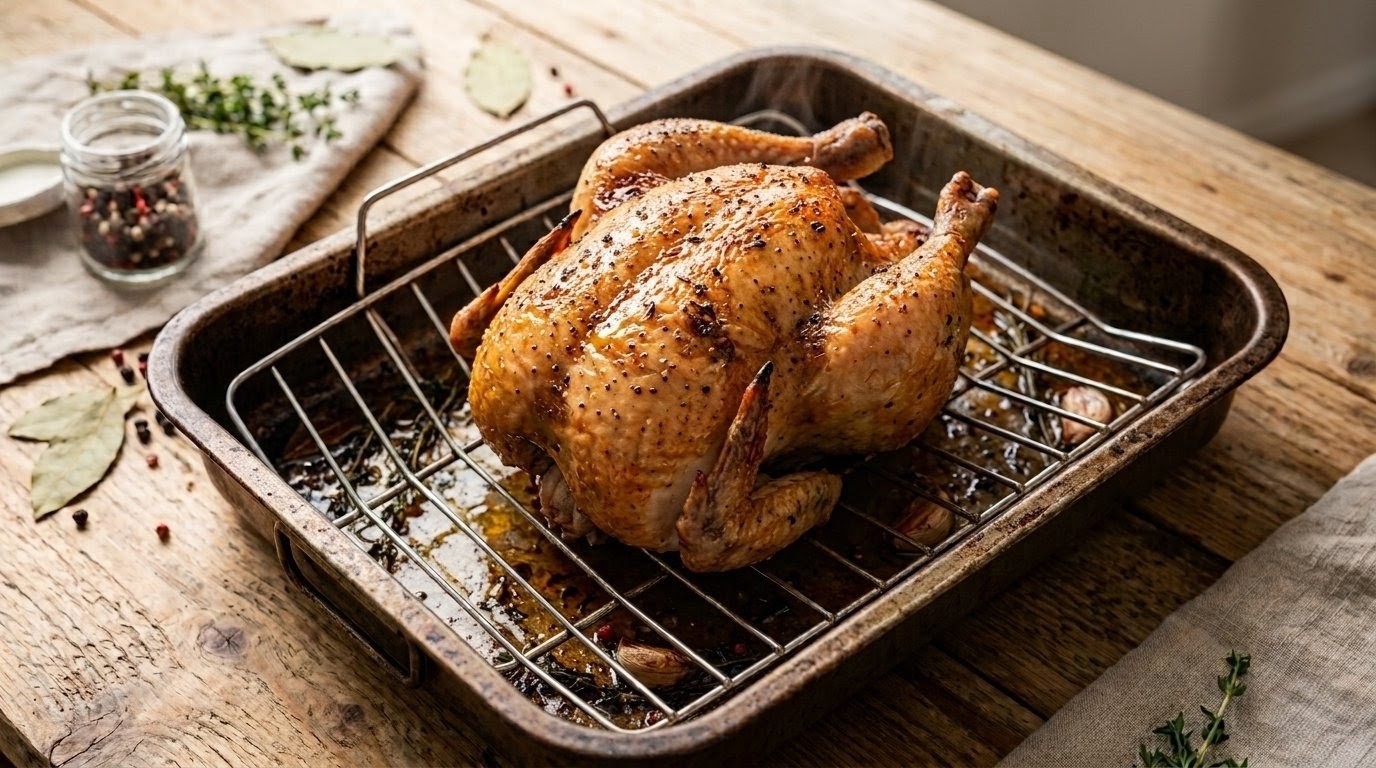
Roast Whole Chicken (one bird, three ways)
One bird, shredded meat for the week, and a freezer bag of bones for tomorrow's stock.
This is the way to actually cook chicken: buy the whole bird, roast it once, then break it down. A 1.6 kg bird gives an estimated 700–900 g of usable cooked meat, depending on the bird and carving losses. The “three meals” idea is dinner for two, another dinner for two, and two sandwich bowls, subject to actual yield and portion sizes. You also get a carcass to turn into proper homemade stock. The method below is built around getting crisp skin without drying the breast, then picking the meat warm so it stays moist.
A 1.6 kg whole chicken gives an estimated 700–900 g of usable cooked meat and the base for everything else you cook that week. “Three meals” means dinner for two, another dinner for two, and two sandwich bowls — subject to the actual yield and your portion sizes.
- →The wet brine is insurance against dry breast. Salted water moves into the muscle and the proteins hold on to more of their own moisture through cooking, so the breast stays juicy even as the thigh catches up. It seasons the bird beyond just the surface, which is why the skin only needs a light 3 g pinch of flaky salt for crisping, not a full re-salting.
- →Dry skin + hot start = crisp. Patting the brined bird bone-dry matters more than ever, because you have just soaked it. The 20-minute blast at 220°C then sets and browns the skin via the Maillard reaction. Wet skin or a cold oven and you boil the skin into rubber instead.
- →Drop the heat to finish the meat gently. A further 75 to 95 minutes at 160°C fan-forced / 180°C conventional (giving an estimated total roasting time of 95 to 120 minutes for a 1.6 kg bird) cooks the bird evenly through. It allows the thigh joint to reach at least 75°C for tenderness without scorching the outside, giving home cooks the buffer to bring the whole bird to 75°C, or experienced cooks the control to pull earlier for carryover resting.
- →Resting is not just patience. Twenty to twenty-five minutes lets the juices settle back into the meat instead of pouring onto the board. It costs nothing and it is the difference between juicy and dry.
- →Picking the chicken while it is still warm makes clean work of the carcass. The connective tissue and gelatine have not fully set, so the meat releases more easily from joints, cartilage and bone. Any resting juices and rendered fat can then be worked back through the picked meat to keep it succulent.
Common Mistakes
- ✗Not drying the bird properly. Wet skin steams instead of crisping — pat it thoroughly dry with kitchen paper, inside and out, before it goes in the oven.
- ✗Salting it again after brining. The brine has already seasoned the bird — a second full salting makes it far too salty. Stick strictly to the 3 g light finishing pinch on the skin.
- ✗Leaving it in the brine too long. Eight to twelve hours is the window — stick to it.
- ✗Going by juice colour or panicking at pink near the bone. Clear juices do not guarantee doneness, and pink or reddish colour around the bones is natural marrow pigment in young birds, not undercooking. Trust your probe reading (Step 6) rather than the clock or visual guesswork.
- ✗Carving immediately. The juice puddle on the board is exactly the juice that should be in the breast. Always let the bird rest covered for the full 20 to 25 minutes (Step 7).
- ✗Binning the carcass. That's free stock. Always. Bag it, freeze it, use it.
Tips & Tricks
- →When you are buying the 1.6 kg chicken for this recipe, compare its price with the next size up. A slightly larger bird can sometimes cost very little more while giving you considerably more usable cooked meat for leftovers, although the exact yield depends on the bird and your portion sizes. If the chicken is sold with the neck attached, remember the neck is included in the weight you are paying for. If you are not going to use it, that is paid-for weight being discarded; if you make stock, keep it, because the neck is excellent for stock.
- →A digital probe thermometer is the only honest way to check doneness. Cooking times are always estimates because oven thermostats fluctuate and bird shapes vary; only an internal probe reading tells you what is happening inside the meat. A reliable probe costs around $25–$30 AUD and ends the guesswork forever.
- →Save the rendered chicken fat from the tray. Strain it into a clean jar, refrigerate it, and use it for roast potatoes or anywhere you want rich chicken flavour.
- →Freeze the shredded meat in single-portion 150 g tubs. That's exactly what you need for one soup serve, one wrap, or one pasta — defrost only what you'll eat.
- →Chef's Tip: The Juiciest Roast Chicken For the juiciest results, start with a fresh, good-quality chicken, preferably from a butcher or supplier you know and trust. Experienced cooks can remove the bird from the oven early and use carryover heat to finish the cooking during resting. Chicken breast can be beautifully juicy at 65°C when held for approximately 10 minutes, or 70°C for around 2 minutes. The legs benefit from reaching a higher temperature for tenderness.
Flavour Twists
Double the garlic in the cavity and rub the butter with the zest of the lemon before smearing on. Brightest, most Mediterranean version.
Mix 5 g smoked paprika and 2 g dried oregano directly into the softened butter before applying it to the chicken. Gives the skin a deep mahogany colour and a faint Spanish edge — excellent shredded into rice the next day.
Substitutions
- Butter→ 20 ml olive oil (1 tablespoon), in place of the 20 g butter.Same coverage over the breast and legs. Skin still crisps but stays a touch paler. Good if you are going for a Mediterranean-leaning leftover plan, and as butter is the only dairy in the recipe, this swap makes the whole roast dairy free.
- Lemon→ Half an orange, halved.Sweeter and mellower than lemon, with a softer citrus edge for the roast and its leftovers.
- Fresh thyme→ 1 tsp dried thyme, or fresh rosemary.Dried thyme in the butter, not in the cavity. Rosemary is fine straight in the cavity.
Carved meat: remove it from the carcass promptly after carving, transfer to shallow containers and refrigerate promptly at 5°C or below — up to 3 days in the fridge, or up to 2 months in the freezer in 150 g single-serve portions. Bones: straight into a labelled freezer bag for stock, along with the roasted garlic, onion and thyme — but not the roasted lemon. Keep building the bag up across multiple roasts. Pan juices and rendered chicken fat: strain into a clean jar, refrigerate, and use for roast potatoes or other cooking.
Keep the seasoning honest on the bird itself — salt, pepper, butter, lemon, garlic, herbs. The point of a roast chicken in the rotation is that it goes anywhere next: a curry, a Thai soup, a Caesar, a chicken and leek pie. Over-flavour it now and you box yourself in for the leftovers.
Build the week around it
Four portions from the one bird: night one is a roast dinner for two with potatoes and greens, then the shredded meat covers two more single portions — a wrap or salad, and a bowl of turmeric chicken soup built on stock made from these bones. Feeding four at the table instead? Serve the lot on night one and the bones still go in the freezer for stock day — see the linked Roast Chicken Bone Stock recipe.
One bird, three meals from the roast and the leftovers, and a bag of bones in the freezer. That’s the cheat code.
Method
- 1
Wet-brine the bird
Dissolve the 50 g salt fully in the 2.5 litres of cold water — that's a 2% brine, the right strength for a 1.6 kg chicken. Add the 5 g whole peppercorns and a generous handful of fresh herbs — use whatever you have or love. Bay, thyme, rosemary and parsley all work really well, but oregano, marjoram, dill and even basil work too. If you're using basil, give it a good beating first to bruise the leaves and release the flavour before it goes in. Lower the chicken in breast-down so it is fully submerged — weigh it down with a small plate if it wants to float — cover, and refrigerate for 8 to 12 hours, or overnight. Keep to the 8 to 12 hour window.
- 2
Drain and dry the bird
Once brined, lift the chicken out and discard the brine completely. Submerge the bird in fresh, ice-cold water for 5 minutes to reduce the brining process. Remove and pat thoroughly dry with kitchen paper, inside and out, making sure to get right into the cavity. Place the chicken on a tray or wire rack and return it to the fridge, uncovered, for a minimum of 4 hours, preferably 8 hours or longer, to allow the skin to dry thoroughly before roasting.
- 3
Stuff the cavity
Push the lemon halves, garlic, thyme and half the onion into the cavity. This perfumes the meat from the inside as it roasts and gives you a head start on aromatics for the gravy. Tie the legs loosely with string if you have it — not essential, but it helps the breast cook evenly.
- 4
Butter, oil, seasoning, into a hot oven
Smear the softened butter over the breast and legs, then drizzle the olive oil. Scatter the 3 g of flaky salt and crack over the 1 g of pepper. The brine has already seasoned the chicken, so be careful about adding any extra salt, as it could make the finished chicken too salty. Sit the bird on the remaining onion quarters in a roasting tray (the onion lifts it off the base and caramelises into the pan juices). Roast at 200°C fan / 220°C conventional for 20 to 25 minutes to set and colour the skin.
- 5
Drop the heat and finish
Reduce the oven temperature to 160°C fan-forced / 180°C conventional and roast for a further 75 to 95 minutes for a 1.6 kg bird. Together with the first 20 to 25 minutes, that gives an estimated total roasting time of 95 to 120 minutes — a guide, not a fixed cooking requirement. Start checking the chicken's internal temperature with a probe 65 minutes after reducing the oven temperature. All cooking times are estimates: the internal temperature measured by the probe determines when the chicken is cooked, not the clock. If the skin is browning too fast, tent loosely with foil.
- 6
Check doneness with a probe, not the juices
Check doneness with a digital probe thermometer inserted into the thickest parts of the meat without touching bone. Use the probe reading to determine doneness, not the clock or the colour of the juices. For Home Cooks (Standard / Foolproof): Roast until both the thickest part of the thigh and the thickest part of the breast reach 75°C on your probe before taking the bird out. This is the simple, foolproof target for household cooking. For Experienced Chefs (Carryover Technique): Ensure the thigh reaches at least 75°C, but pull the bird when the breast reads 65°C to 70°C. You must immediately keep the bird covered completely in the warm tray (or insulated container) for the full 20 to 25 minute rest to allow carryover heat to safely finish cooking the breast (see the Chef's Tip in Tips & Tricks for holding times). A note on pink around the bone: properly cooked chicken can still have pink or reddish colouring around the bones, especially in the drumsticks and thighs. That is natural myoglobin and bone-marrow pigment in young birds, not undercooking. Once your probe target is met and the bird has rested covered, colour at the bone does not mean it is underdone.
- 7
Rest properly — this is non-negotiable
Leave the bird right in the warm roasting tray (or transfer to an insulated container like a Thermoserve) and cover it completely for 20 to 25 minutes before carving. Trapping that residual heat allows carryover cooking to finish the meat while settling the juices back through the chicken. Carve too early and the juice ends up on the board instead of in the meat. If you are making gravy, pour off the pan juices first while keeping the bird covered.
- 8
Carve, then shred for the week
A 1.6 kg bird gives an estimated 700–900 g of usable cooked meat in total; the actual yield depends on the bird and carving losses. The plan is dinner for two tonight, another dinner for two later, and two sandwich bowls, subject to your actual yield and portion sizes. Carve the breasts and legs for the plates. Then, while the chicken is still warm, pick every scrap of meat from the carcass with two forks or clean hands. The connective tissue and gelatine have not fully set, so the meat separates cleanly from the joints, cartilage and carcass. Work any resting juices and rendered fat back through the picked meat to keep it succulent. Remove all the leftover meat from the carcass promptly after carving, transfer it to shallow containers and refrigerate promptly at 5°C or below. Keep it in the fridge for up to 3 days or freeze it for up to 2 months in single-portion tubs, ready for soups, wraps, salads and pasta.
- 9
Save the bones — this is the whole point
Drop the stripped carcass, wing tips, the back, any bony bits and the skin trimmings straight into a freezer bag. From the cavity, keep the roasted garlic, the roasted onion and the thyme — they all belong in stock. Leave out the roasted lemon halves: the cooked pith turns stock bitter and sour, so bin those. Seal, label, freeze. Next time you roast a chicken, add those bones too. Once you have two carcasses' worth, you have enough for a proper batch of stock — see the linked Roast Chicken Bone Stock recipe.
Leave a comment
Drop your name, email and a note — I read every one.