
Rice
Flavour Profile
Neutral, mild and gently nutty. Rice is a blank canvas that carries salt, fat, acidity, spice and whatever sauce you throw at it.
Brown rice is earthier and chewier. Aromatic varieties such as jasmine and basmati bring their own floral, popcorn-like fragrance.
Health Benefits
Rice is mainly carbohydrate, which the body uses for energy. Brown rice retains its bran and germ, so it provides more fibre than white rice.
Rice is naturally gluten-free, including glutinous or sticky rice — “glutinous” describes its sticky texture, not the presence of gluten.
Buying Tips
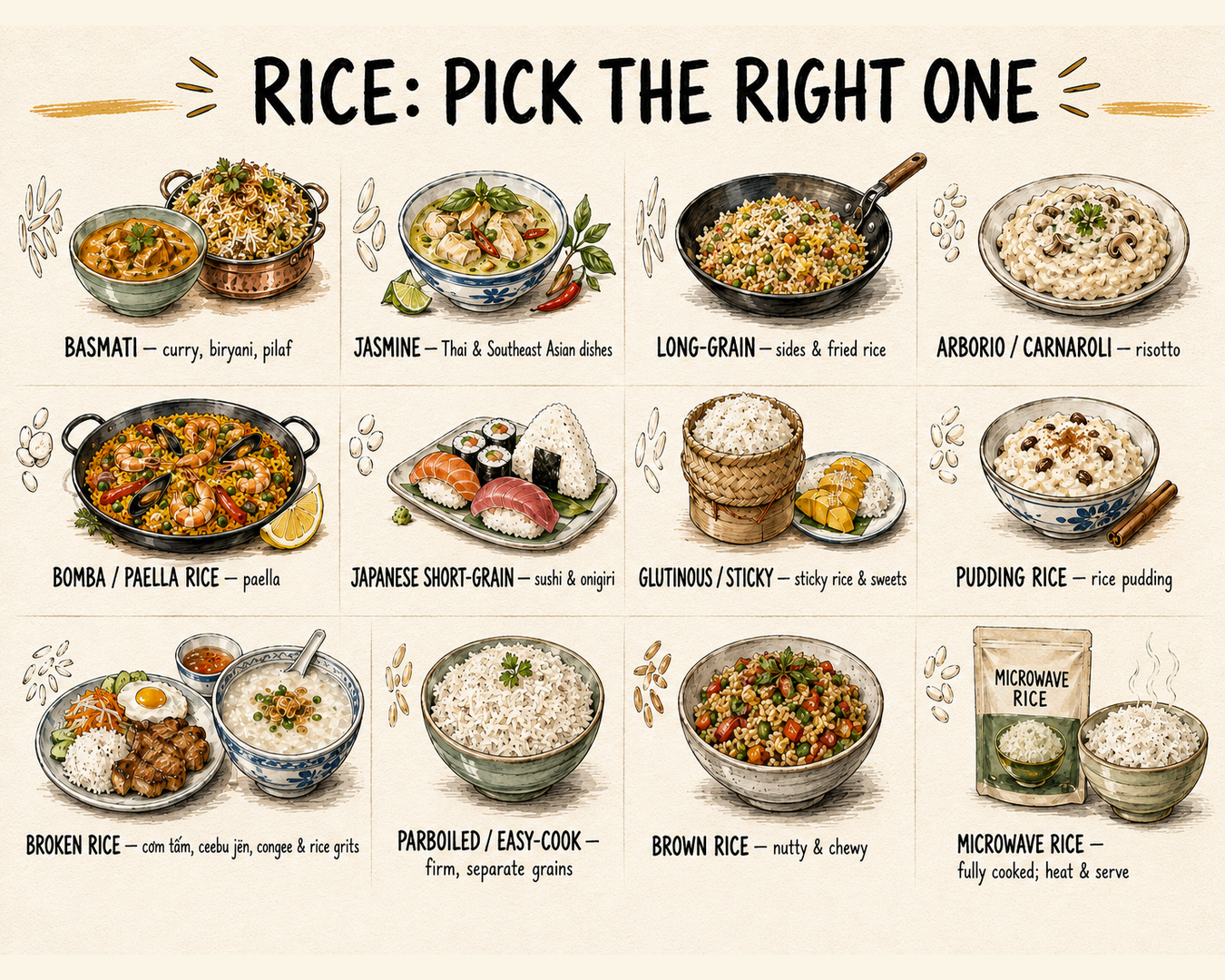
Buy rice for the dish you are cooking. Basmati suits curries, biryani and pilaf; jasmine suits Thai and other Southeast Asian meals; ordinary long-grain is a useful all-rounder for side dishes and fried rice.
Parboiled rice, sometimes sold as converted or easy-cook rice, has been soaked, steamed and dried before milling. It usually takes longer to cook than ordinary white rice but produces firm, separate grains that hold their shape well. It is useful for batch cooking and dishes where you do not want the grains clumping together.
Microwave rice is fully cooked rice sealed in a pouch or cup. It only needs reheating, so follow the heating instructions on the packet.
For risotto, choose Arborio or Carnaroli. For paella, choose bomba or a packet labelled paella rice. Use Japanese short-grain for sushi and onigiri, glutinous rice for sticky rice and desserts, and pudding rice for rice pudding.
Broken rice is deliberately sold and used in dishes including Vietnamese cơm tấm, Senegalese ceebu jën or thieboudienne, congee and other rice porridges, and Southern US rice grits. Its smaller pieces cook faster, soften more readily and absorb sauces and broths well. Broken rice is a useful ingredient, not simply damaged or inferior rice.
Brown rice gives a nuttier, chewier result but takes longer to cook.
If the rice provides an important part of the dish’s texture, buy the specific variety named in the recipe.
Storage
Keep uncooked rice in a cool, dry place in an airtight container. Brown rice spoils faster than white rice because its bran and germ contain oils, so buy smaller amounts and use it sooner.
Cooked rice can contain Bacillus cereus spores that survive cooking. Food-safety temperature limits vary slightly between countries, but keeping cooked rice at 5°C or colder or 63°C or hotter is a safe rule across Australia, New Zealand, the UK, the US and Canada.
If the rice is not being kept hot, divide it between shallow containers and refrigerate it promptly, ideally within one hour.
Do not leave cooked rice sitting on the bench until it feels completely cold. Slow cooling can allow bacteria to grow and produce toxins that reheating may not destroy.
Use refrigerated rice within two days and reheat only what you need until it is steaming hot.
Cooking Uses
For covered absorption cooking, standard white rice generally uses 1 part rice to around 1.5–2 parts water by volume. This is a starting range, not a universal rule. Water quantities, cooking times, cooking methods and rinsing instructions vary between varieties, processing methods and brands, so follow the instructions on the packet you bought.
Use rice as a base for stews and curries, in pilafs, salads and puddings, or fry it with leftovers.
For fried rice, the real target is cold, dry grains. Rice cooked, cooled quickly and refrigerated the day before is ideal. Freshly cooked rice can also work if you spread it thin, allow the steam to escape, cool it quickly and chill it before frying.
Forkin Food Theory
Rice is a starch sponge, but it has a memory.
Cooking causes its starch to absorb water, swell and soften. As the rice cools, some of that starch realigns and firms up through a process called retrogradation.
That is why fridge-cold rice fries better: the grains are drier and physically firmer, so they are less likely to break down when they hit the hot pan.
Cooling also converts a small amount of the starch into resistant starch, which is digested less readily. It is an interesting change, but it does not magically turn rice into a low-carb food.
Fresh, steaming rice goes soft in the pan. Cold, dry rice gets fried.
Wild & Wonderful
Long or short does not tell the whole story. The variety and balance of its different starches determine whether rice cooks fluffy, creamy or clingy.
Rinsing is not a universal rule. When the packet or recipe calls for it, rinsing removes loose surface starch and can help the grains cook more separately. Some manufacturers specifically tell you not to rinse their rice, so follow the instructions on the packet.
Do not rinse risotto rice unless the recipe specifically tells you to — you want that starch in the pan.
Brown rice is the whole grain with the bran and germ intact. White rice has both layers milled away. Brown rice therefore takes longer to cook and goes rancid faster because those outer layers contain oils.