Parmesan
Flavour Profile
Sharp, salty, and intensely nutty. It delivers a massive hit of umami with a slightly grainy texture.
As it ages, the flavour becomes more concentrated and complex, shifting from lactic and sweet to spicy and savoury.
Health Benefits
Parmesan is a good source of calcium, which builds strong bones, and protein, which builds muscle.
Being an aged cheese, most of the lactose is gone, so it's often fine for those who usually struggle with dairy. It's a flavour powerhouse, so a little goes a long way. Eat it in moderation, like any cheese.
Buying Tips
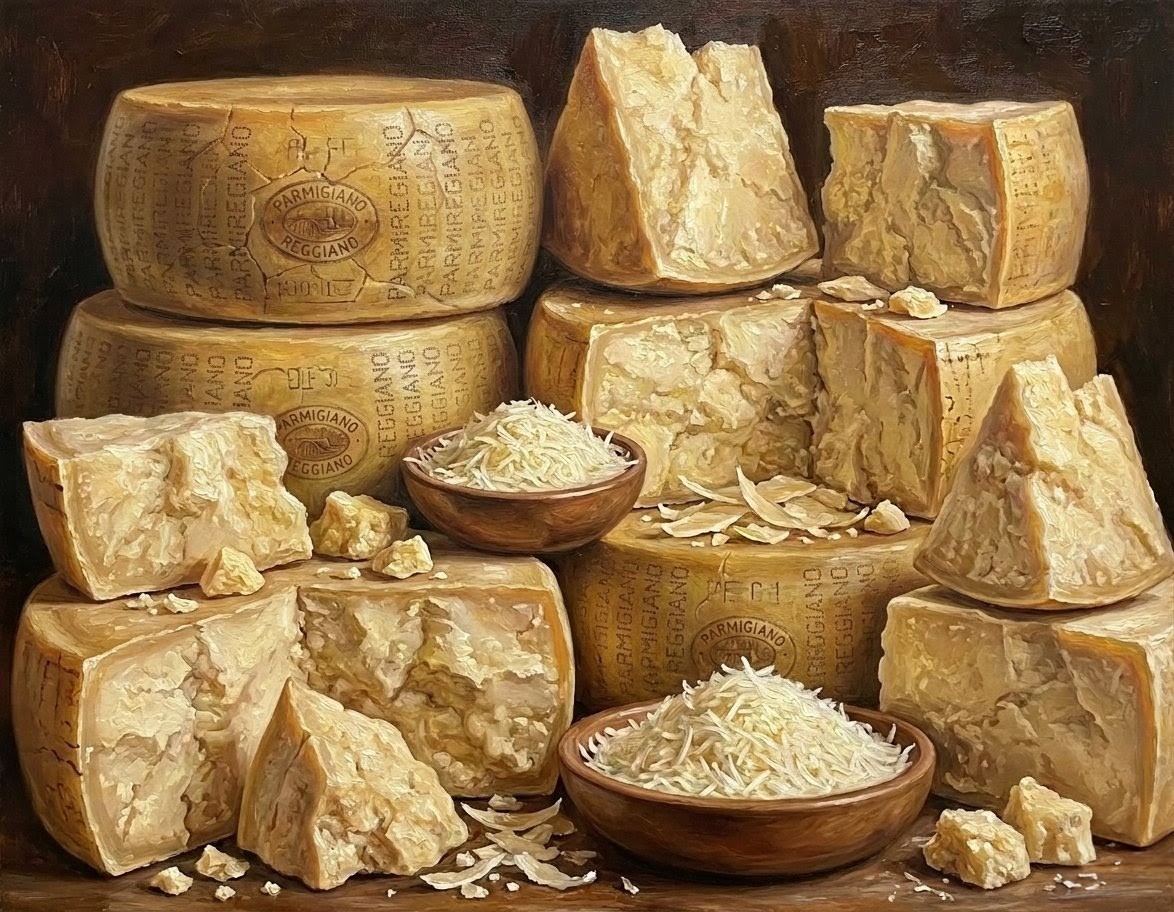
Look for the stamp. Genuine Parmigiano Reggiano has its name pin-dotted into the rind.
Avoid the pre-grated green shaker cans. That is mostly cellulose and disappointment. Buy a block and grate it yourself; you get better melting and more flavour for your money.
Storage
Wrap your block in parchment or wax paper, then loosely in foil or a reusable beeswax wrap.
Avoid plastic wrap if you can, as it can trap moisture and cause the cheese to sweat or grow mould. Keep it in the coldest part of your fridge.
Cooking Uses
Grate it over pasta, shave it into salads, or stir it into risotto at the very end to create a creamy emulsion.
Don't throw away the rinds. Toss them into soups, stews, or stocks while they simmer to extract every last bit of umami goodness.
Forkin Food Theory
Those little white crunchy bits in aged Parmesan are not salt.
They are actually crystals of tyrosine, an amino acid. As the cheese ages, proteins break down and these crystals form.
They are the hallmark of a well-aged cheese and provide a structural 'pop' that signals high-quality savoury depth. If your cheese is crunching, you’re doing it right.
Wild & Wonderful
If it doesn't say Parmigiano Reggiano DOP and have the dots burned into the rind, it isn't parmesan. It's hard cheese pretending.
The DOP version is made in a specific part of Italy, with raw milk, aged a minimum of 12 months (often 24 or 36), and contains no additives. The crystals you bite are amino acid crystals that form with age. That's a good sign.
Pre-grated "parmesan" in tubs is mostly old cheese powder, cellulose, and salt. It tastes nothing like the real thing.
Keep the rinds. They go in stocks, soups, sauces, and beans. That's free flavour.