
MSG
Flavour Profile
MSG delivers pure umami — the deep, meaty, mouth-filling savouriness that makes soups taste like they've simmered for hours and roast meats taste more like themselves. On its own it is faintly salty, slightly meaty, and almost sweet. In food, it doesn't add a new flavour — it amplifies the savoury flavours already there.
Health Benefits
**Health & Safety**
MSG is one of the most studied food ingredients in the world. Major food safety bodies — including the FDA, EFSA and the WHO/FAO — have repeatedly reviewed the evidence and classify it as safe at the levels used in cooking.
The long-running "Chinese Restaurant Syndrome" story from the 1960s was never backed by controlled evidence. Modern double-blind trials have failed to link normal culinary use of MSG to headaches or other symptoms.
A useful comparison: gram for gram, MSG contains about a third of the sodium of table salt. Using a small amount of MSG in place of some of the salt can lower the total sodium in a dish while keeping the savoury flavour intact.
**Common Mistakes**
- Treating MSG as a replacement for salt (it works alongside salt, not instead of it) - Using too much — a pinch across a whole pot is usually enough - Adding it to already very salty dishes and expecting a big change - Assuming it will "fix" a dish that's under-seasoned in other ways
Buying Tips
**What To Look For**
MSG is sold as small white crystals, similar in look to fine salt or sugar. It's usually labelled "MSG", "monosodium glutamate", or under brand names like Ajinomoto or Aji-no-moto.
Look for:
- A single ingredient: monosodium glutamate - Fine, free-flowing crystals - A resealable pouch or shaker jar
Avoid "flavour enhancer" blends that pad MSG out with other additives if you want to control the amount yourself.
Storage
**How To Store It**
Store MSG the same way you'd store salt:
- In a sealed jar or shaker - In a cool, dry cupboard away from steam - Out of direct sunlight
It doesn't spoil. Kept dry, it lasts effectively forever. If it clumps, break it up with a fork — it's still fine to use.
Cooking Uses
**What Is It?**
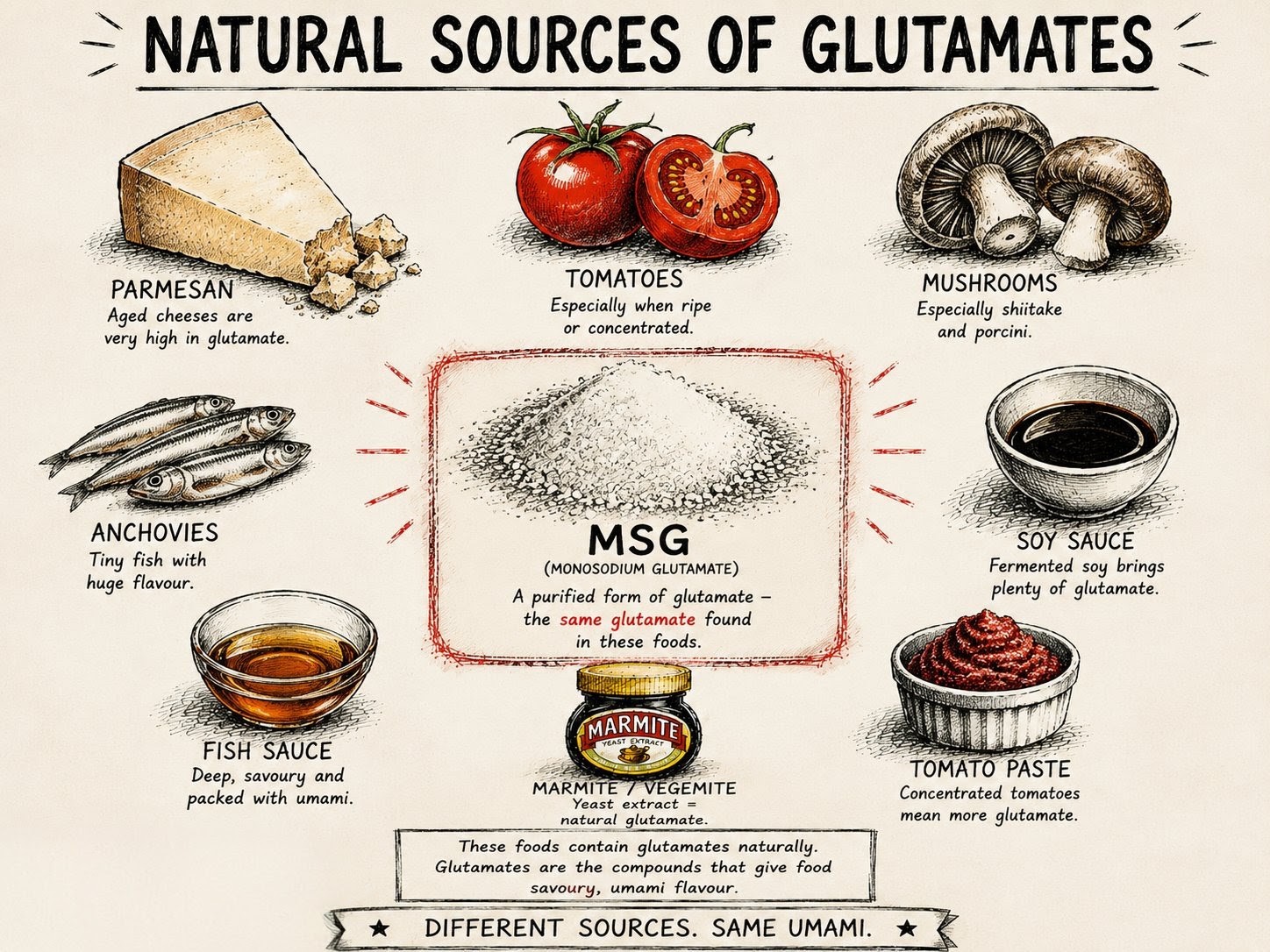
MSG stands for monosodium glutamate. It is the sodium salt of glutamic acid, an amino acid found naturally in tomatoes, Parmesan, mushrooms, soy sauce and cured meats.
Despite what has been repeated for years, MSG is not a mysterious laboratory powder. It is simply a concentrated source of glutamate — one of the compounds your tongue registers as umami, the fifth basic taste alongside sweet, sour, salty and bitter.
**What Does It Do?**
MSG makes savoury food taste more savoury. It rounds out broths, deepens stews, boosts burgers and mince, and gives roast potatoes and gravies a fuller, more satisfying finish. It doesn't taste of much on its own — its job is to make the other ingredients taste more like themselves.
**How Does It Work?**
Glutamate binds to specific umami receptors on the tongue. When it does, the brain reads the food as richer, meatier and more complete. A tiny amount goes a very long way: a pinch across a whole pot is usually enough.
**Household Uses**
- A small pinch in soups, stews and gravies - Mixed into burger or meatball mince before shaping - Sprinkled onto roast potatoes or chips with the salt - Stirred into stir-fries and fried rice at the end of cooking - Added to marinades for chicken, pork or beef
**Professional Kitchen Uses**
Professional kitchens have used MSG quietly for decades — in stocks, sauces, seasoning blends, and finishing salts. It is one of the cheapest ways to add depth without adding another loud flavour that has to be balanced against everything else on the plate.
Forkin Food Theory
**Why does a pinch of MSG make soup taste like it's been simmering all day?**
Because your tongue has receptors dedicated to glutamate, and MSG delivers it in a pure, concentrated form.
**The Formula**
🧂 MSG ↓ 👅 Umami receptors ↓ 🧠 Savoury signal amplified ↓ 🍲 Deeper-tasting food
When glutamate lands on those receptors, the brain reads the whole dish as richer and more complete — even if nothing else has changed. That is why chefs describe MSG as a "flavour enhancer" rather than a flavour of its own.
**Myths & Misconceptions**
- **"MSG is artificial."** Glutamate is found naturally in tomatoes, cheese, mushrooms, seaweed and cured meats. MSG is just an isolated form of it. - **"MSG causes headaches."** Controlled studies have not shown this at normal culinary levels. - **"MSG is only in Chinese food."** Parmesan, soy sauce, tomato paste, cured meats and many crisps and stocks are all high in glutamate. - **"MSG is unhealthy."** It contains about a third the sodium of table salt and is classed as safe by every major food safety body. - **"You can taste MSG in the dish."** Used correctly, you can't. You just notice the food tastes fuller.
Wild & Wonderful
**The Takeaway**
MSG is one of the cheapest, cleanest and most useful savoury tools in the kitchen. A pinch in the pot, a pinch on the mince, a pinch in the gravy — that's usually all it takes.
Food works better when you understand it.
**Quick Facts**
- Discovered in 1908 by Japanese chemist Kikunae Ikeda while studying kombu (kelp) broth - Ikeda named the taste "umami" — meaning "pleasant savoury taste" in Japanese - Naturally present in Parmesan, tomatoes, mushrooms, soy sauce, anchovies and cured meats - Contains roughly one third the sodium of table salt - Classed as safe by the FDA, EFSA and the WHO/FAO - Best added in small amounts during cooking or as a final seasoning - Main benefit: more savoury depth without adding another strong flavour on top
**A note from the glen**
**Can I Leave It Out?**
Yes. Every recipe on the site works without MSG. It is an optional flavour tool, not a required ingredient. Leaving it out means the savoury notes will be a little quieter — nothing more.
**Can I Substitute It?**
You can lean on other glutamate-rich ingredients to get some of the same effect:
- Soy sauce or fish sauce (add saltiness too) - A spoonful of miso or yeast extract - Grated Parmesan or a Parmesan rind in the pot - Tomato paste, mushroom powder, or dried seaweed
These add flavour of their own as well as umami, so they're not quite a like-for-like swap.
**Used Too Much?**
Too much MSG can make food taste flat, slightly metallic, or oddly "heavy". Balance it by adding more of the other ingredients (more stock, more veg, more meat) rather than trying to remove it. Next time, use less — a pinch, not a spoonful.
**Used Too Little?**
If a dish tastes correctly seasoned but somehow "thin", a tiny pinch of MSG stirred in near the end of cooking often lifts it without changing the flavour direction.