
Milk
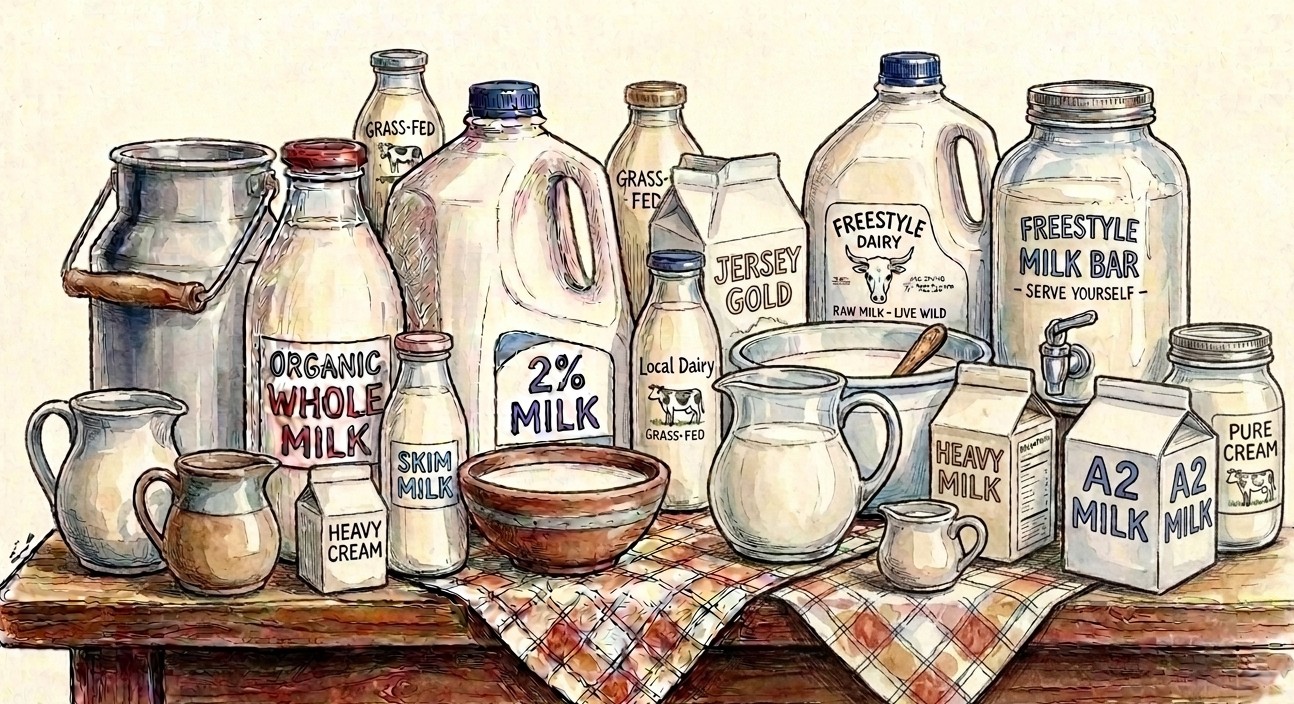
Flavour Profile
Creamy, slightly sweet and neutral. It has a subtle richness that rounds out bitter or acidic flavours in coffee and sauces.
Health Benefits
Calcium for strong bones and teeth, which is a good thing for anyone who plans on chewing food or having their skeleton stay upright.
You also get a decent hit of vitamin B12, which helps turn your food into usable energy. Not much point eating if you can't get the goodness out of it.
Buying Tips
Check the fat content. Whole milk (blue top) is the standard for cooking because fat carries flavour. If you're buying plant-based alternatives, look for 'barista' versions; they usually have added fats and proteins to mimic the structural behaviour of cow's milk.
Storage
Keep it in the coldest part of the fridge, not the door. Most people put it in the door, but the constant opening and closing causes temperature fluctuations that make it turn sour faster. Always keep the lid tight to prevent it absorbing the smells of your leftover curry.
Cooking Uses
Milk is the base for classic mother sauces like Bechamel. Use it to poach fish for a delicate texture, or add it to mashed potatoes for creaminess without the heavy richness of butter. It also acts as a tenderiser in marinades for chicken or pork.
Forkin Food Theory
Milk is a natural emulsifier. It is essentially fat droplets suspended in water, held together by proteins.
This is why a splash of milk can often rescue a sauce that is starting to split.
The proteins act as a bridge between the fat and the liquid, bringing the whole pan back into a smooth, cohesive harmony.
Wild & Wonderful
What the cow ate matters more than the percentage on the bottle.
Grass-fed milk has a different fat profile and tastes faintly sweet. Year-round high-yield milk from grain-fed indoor herds is more uniform and more bland.
UHT milk has been blasted at 140C+ to kill everything in it, including most of the flavour. It works for cooking. For drinking it tastes like a memory of milk.
Homogenised vs not is just whether the cream has been broken up so it doesn't separate. Non-homogenised milk with a cream line on top is closer to what milk actually is.