
Broccoli
Flavour Profile
Earthy, mildly bitter and sweet when cooked properly. It has a sulfurous edge that is balanced by salt and fat.
It acts like a sponge for sauces, making it an elite vehicle for punchy flavours like soy, lemon or melted cheese.
Health Benefits
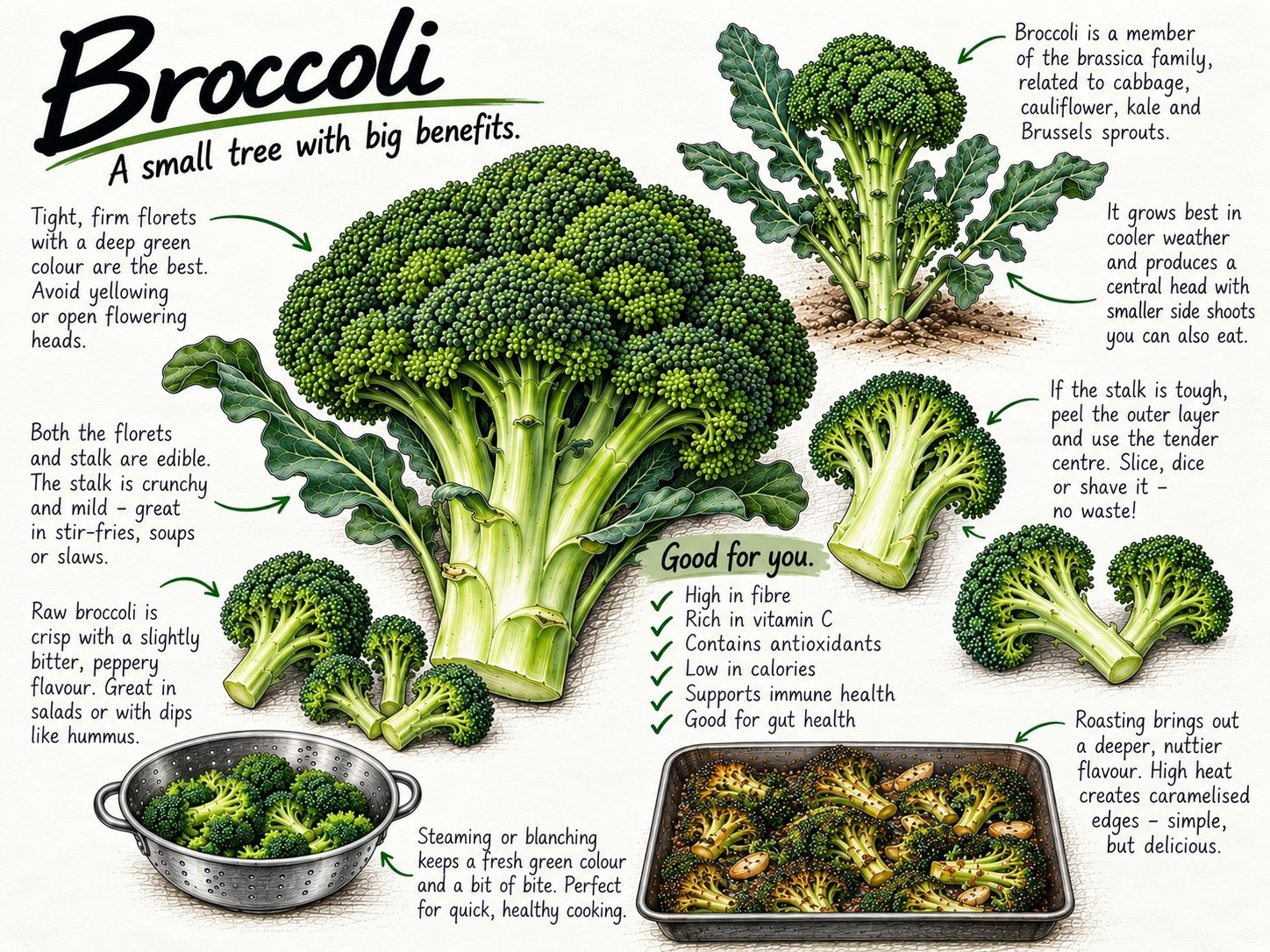
Broccoli is packed with vitamin C for your immune system, and vitamin K, which clots blood. It's also full of fibre, good for keeping your gut happy. Don't boil it to death — that's how you lose the good stuff and make it taste like socks. Steam or roast it lightly.
Buying Tips
Look for tight, firm florets that are deep green or slightly purplish. Avoid anything turning yellow or starting to look limp.
The stems should be solid, not hollow or woody. If the stem feels like a dried branch, the broccoli is past its prime.
Storage
Keep it in the fridge in a perforated bag. It needs to breathe.
If it starts to look a bit sad, trim the bottom of the stem and stand it up in a jar of water like a bouquet of flowers. It will perk right back up.
Cooking Uses
Steaming is the classic move, but roasting broccoli at high heat for 20 minutes transforms it into something sweet and nutty.
Don't bin the stems. Peel the tough outer layer, slice the pale green heart into rounds and sauté them with garlic and chilli. They are the best part.
Forkin Food Theory
Cooking broccoli is a race against its own chemistry.
Crucifers contain an enzyme called myrosinase. When you heat broccoli, you eventually kill this enzyme, but if you cook it too long or too slowly, you unlock those funky, pungent sulfur smells that give broccoli a bad name.
The secret to great broccoli is speed. High heat and short cook times preserve the crunch, the vibrant green colour and the sweetness before those sulfur compounds take over.
Wild & Wonderful
Don't bin the stalk. It's the best bit. Peel the woody outer layer and the inside is sweeter and crunchier than the florets.
Overcooked broccoli releases sulphur compounds — that's the school-dinner smell. Three to four minutes in boiling water, then straight into cold water if you're not serving it immediately. Or roast it hot and fast.
Tenderstem / broccolini and Chinese broccoli (gai lan) are different vegetables. They cook faster and have a more delicate, less brassic flavour.
If the florets are yellowing, the broccoli is past it.